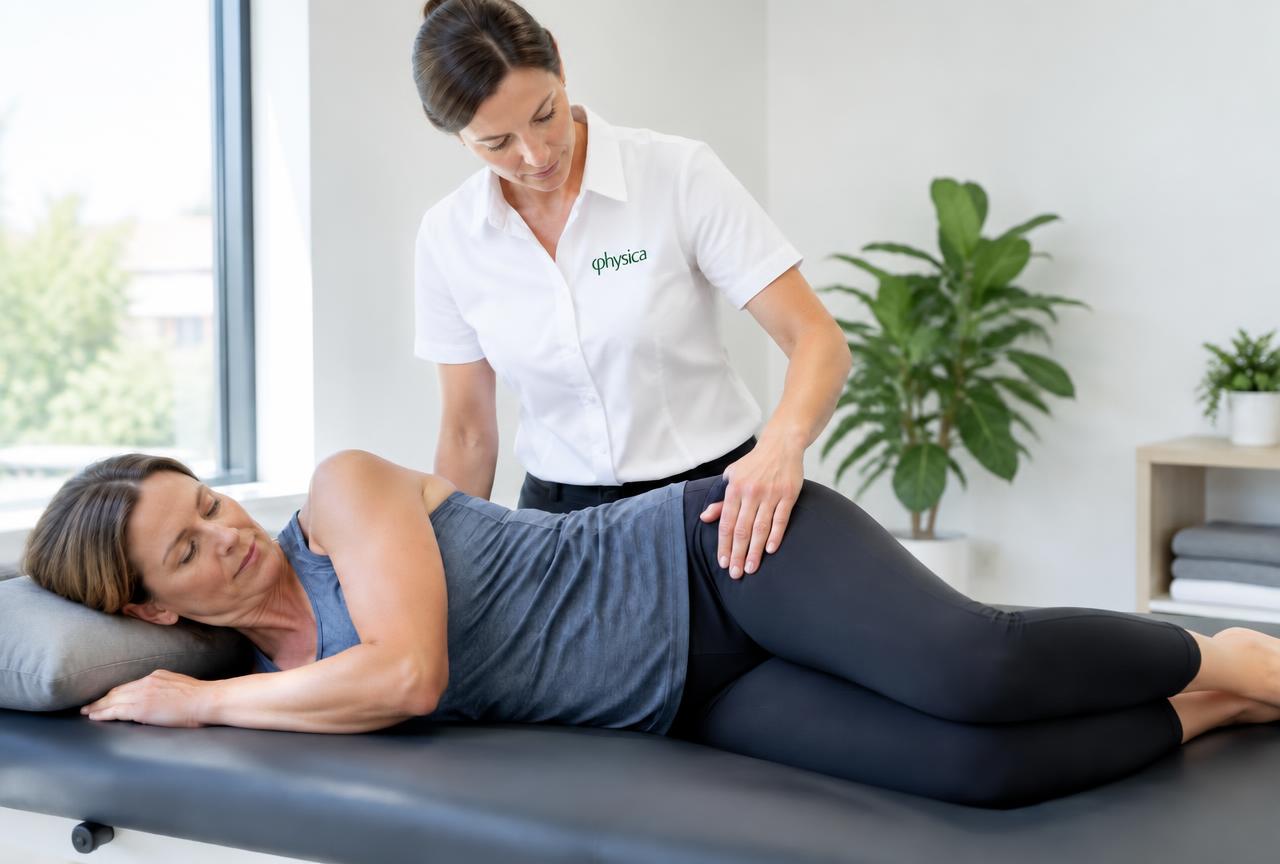
If you have felt pain on the outside of your hip, especially when lying on it, walking or standing for a while, you may have a condition called greater trochanteric pain syndrome (GTPS).
This is a very common condition in physiotherapy, and the good news is that it can be diagnosed through careful assessment and managed well once we understand what is going on.
What is GTPS?
GTPS describes pain coming from structures on the outside of the hip, including:
The gluteal tendons (attached to the muscles that help stabilise your hip)
The bursa (a small fluid-filled cushion that reduces friction)
Rather than being simply “bursitis”, we now know GTPS often involves tendon irritation and overload.
Common symptoms
People with GTPS often report:
Pain on the outside of the hip
Pain when lying on that side, or on the opposite side in more advanced cases
Pain with walking, stairs or standing
Tenderness when pressing on the outer hip
Pain when standing on one leg, for example when putting on pants
Some factors may increase your risk, including:
Reduced hip strength
Changes in walking patterns
Higher body weight
Differences in pelvic shape (Plinsinga et al., 2019)
How is it diagnosed?
One of the most important things to know is that GTPS is diagnosed clinically, through assessment, not just by scans.
Your physiotherapist will guide you through a series of tests to reproduce your symptoms and rule out other causes.
Key tests your physio might use
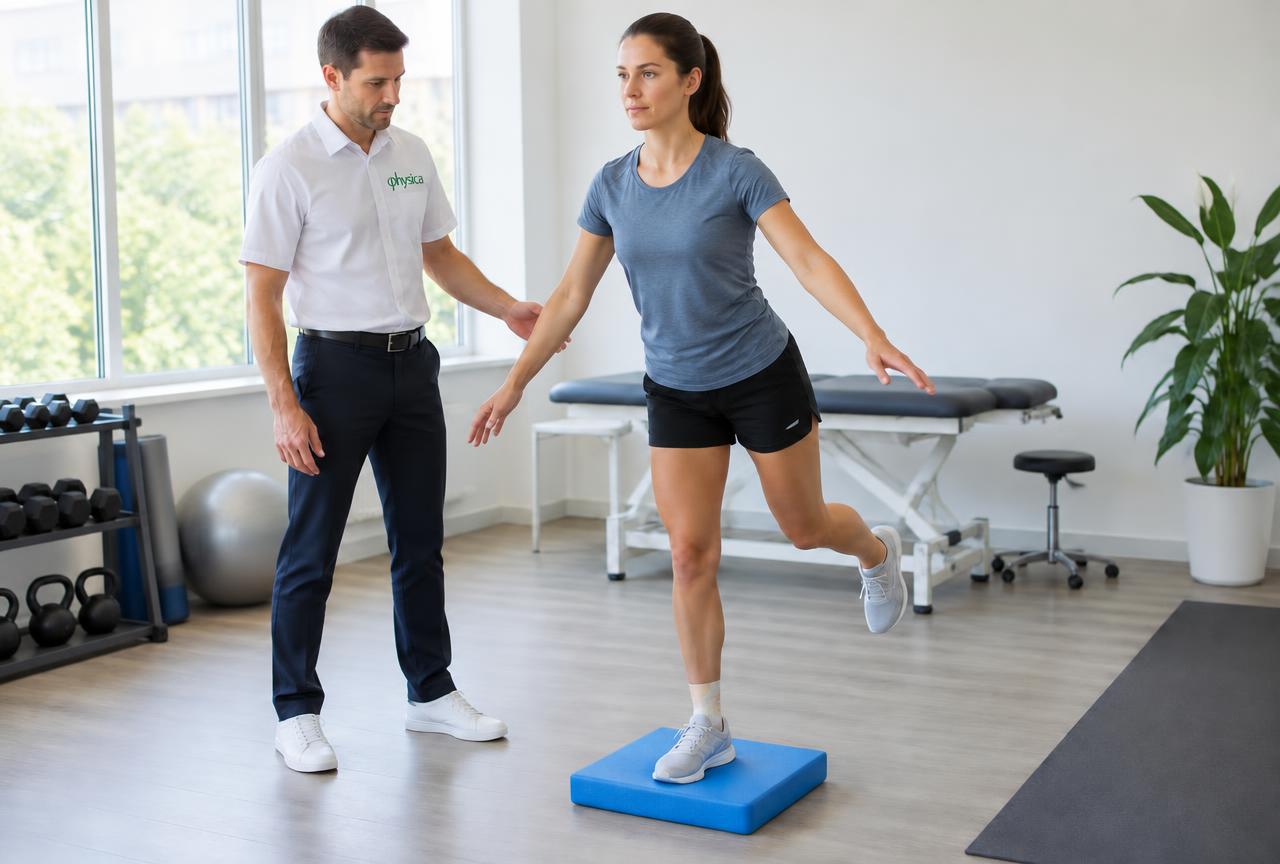
Standing on one leg (single leg stance test)
You will be asked to stand on one leg for up to 30 seconds.
Positive test: pain on the outside of your hip
One of the most accurate tests available: sensitivity 94%, specificity 99% (Kinsella et al., 2024)
Resisted hip movement tests
You may be asked to push your leg outwards against resistance.
Positive test: reproduction of your familiar hip pain
Useful for confirming the diagnosis: specificity up to 90–93% (Grimaldi et al., 2017)
Hip rotation test (external de-rotation)
You will rotate your hip against resistance.
Positive test: pain on the outside of the hip
High diagnostic accuracy: specificity up to 97% (Lequesne et al., 2008)
Palpation of the greater trochanter
Your physio will press on the outer hip.
Positive test: reproduction of your exact pain
Quite sensitive, but less specific (Grimaldi et al., 2017)
Why we don’t rely on just one test
No single test is perfect. Research supports combining:
Your symptoms
Several positive tests
Clinical judgement
Even high-quality research rates overall certainty as only low to moderate, so clinical reasoning matters (Kinsella et al., 2024).
Could it be something else?
Outer hip pain is not always GTPS. Your physio will also consider and rule out:
Hip osteoarthritis
Stiffness and reduced movement
Pain deep in the joint
Referred pain from the lower back (lumbar spine)
Pain that may travel down the leg
Nerve-related symptoms
Tests such as the slump test (84% sensitivity) help screen for this (Majlesi et al., 2008).
Sacroiliac joint (SIJ) pain
Pain around the back of the pelvis
Diagnosed using a cluster of tests: sensitivity 91%, specificity 78% (Laslett, 2008)
Do you need a scan?
In most cases, no. GTPS is diagnosed from your history and a clinical examination, so imaging is not usually needed.
Up to 72.5% of people without hip pain show “abnormalities” on MRI (Woodley et al., 2008). This is why scans must always be interpreted alongside your symptoms.
What does this mean for you?
If you have pain on the outside of your hip:
A thorough physical assessment is more important than a scan.
Simple tests can be highly accurate.
Other causes of pain need to be ruled out.
Imaging is only part of the picture.
Key takeaways
GTPS is a common and treatable cause of hip pain.
Diagnosis is based on clinical assessment, not imaging alone.
Your physio will use a combination of tests for accuracy.
Scans can help, but can be misleading when used on their own.
If outer hip pain is affecting your sleep, walking or activity, our physiotherapists can assess your hip and guide your recovery.
References
Kinsella R, Semciw AI, Hawke LJ, Stoney J, Choong PF, Dowsey MM. Diagnostic accuracy of clinical tests for assessing greater trochanteric pain syndrome: a systematic review with meta-analysis. Journal of Orthopaedic & Sports Physical Therapy. 2024;54(1):26-49.
Lequesne M, Mathieu P, Vuillemin-Bodaghi V, Bard H, Djian P. Gluteal tendinopathy in refractory greater trochanter pain syndrome: diagnostic value of two clinical tests. Arthritis Care & Research. 2008;59(2):241-6.
Grimaldi A, Mellor R, Nicolson P, Hodges P, Bennell K, Vicenzino B. Utility of clinical tests to diagnose MRI-confirmed gluteal tendinopathy in patients presenting with lateral hip pain. British Journal of Sports Medicine. 2017;51(6):519-24.
Plinsinga ML, Ross MH, Coombes BK, Vicenzino B. Physical findings differ between individuals with greater trochanteric pain syndrome and healthy controls: a systematic review with meta-analysis. Musculoskeletal Science and Practice. 2019;43:83-90.
Majlesi J, Togay H, Ünalan H, Toprak S. The sensitivity and specificity of the Slump and the Straight Leg Raising tests in patients with lumbar disc herniation. Journal of Clinical Rheumatology. 2008;14(2):87-91.
Laslett M. Evidence-based diagnosis and treatment of the painful sacroiliac joint. Journal of Manual & Manipulative Therapy. 2008;16(3):142-52.
Woodley SJ, Nicholson HD, Livingstone V, Doyle TC, Meikle GR, Macintosh JE, et al. Lateral hip pain: findings from magnetic resonance imaging and clinical examination. Journal of Orthopaedic & Sports Physical Therapy. 2008;38(6):313-28.