
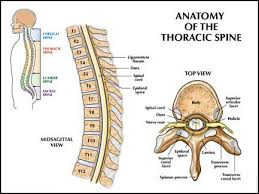
The thoracic spine is the least mobile region of the spine, however this does not mean it is any less important. Due to the presence of the rib cage, shape of the facet joints and relatively small intervertebral discs the movement of this region is mostly limited to rotation, with approximately 6-9 degrees of rotation per segment. In fact, the thoracic spine is the centre for trunk rotation with 60% of standing body rotation coming from the thorax (thoracic cage). The discs are relatively thinner in this region than in the cervical and lumbar spines because the ribs and sternum provide some shock absorption by the distribution of compressive forces.
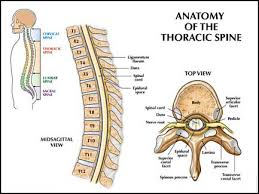
Source: www.spinalforamenotomy.info
The Thorax has six vital functions which are load transfer, shock absorption, centre for respiration (breathing), muscle attachments for head/neck/scapula/lumbar spine/pelvis muscles, contains the sympathetic nervous system (to send messages which run your vital organs) and the rib cage protects your heart/lungs and some of your abdominal organs. The Thorax is also an adjustor of your centre of mass which is essential for postural control and balance. Hence this region plays an essential role in your whole body functioning.
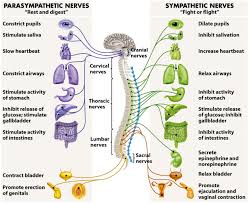
Source: www.galbraithchiropractic.com
A unique feature of the thoracic spine is that it is a connecting link between the neck and lower back and hence transitions between these very different spinal designs. The functional thoracic spine can be considered to be between about T3 and T10. Above T3 it behaves like the cervical spine and below T10 it performs like the lumbar spine. There are in fact 13 joints between each typical thoracic spinal unit and a whopping 136 joints in the entire thorax.
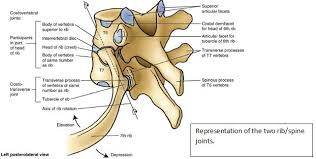
Source: www.primephysiotherapy.com.au
The cervical and lumbar spines have a biomechanical dependence on the thoracic spine. A good example to test this is to stand up, slouch your upper body, then see how far you can rotate your neck to the left and right. Compare this with standing straight with good posture. You could also try and see how far you can lift your arm out in front of you in these same 2 postures. What do you notice about your range of motion?
Many of the muscles that move the neck have their origins in the upper thoracic spine. Because they attach to the bones in the thoracic region and are supplied by nerves coming from the cervical spine, issues in the neck can actually cause pain to be felt in the thoracic region.
As you can see the thoracic spine has a key role to play with you neck and lower back. It is likely that your physiotherapist will assess your thoracic spine if you present with neck or low back pain.